
June 3, 2026 · CarpetPros
Steam Cleaning vs. Dry Carpet Cleaning: Which Is Better?
- Carpet Cleaning
- Cleaning Methods
- Guide
- Hot-Water Extraction
Short answer: for most homes, steam cleaning (hot-water extraction) is the better choice. It cleans deepest, pulls out the allergens and oily soil a surface clean leaves behind, and it’s the method most carpet manufacturers require to keep your warranty valid. Dry cleaning earns its place where you genuinely can’t wait hours for carpet to dry — like a busy office or a hallway that has to stay open. Below we break down exactly how each method works, what they cost, how long they take to dry, and which one to pick for your specific situation.
Steam cleaning (hot-water extraction)
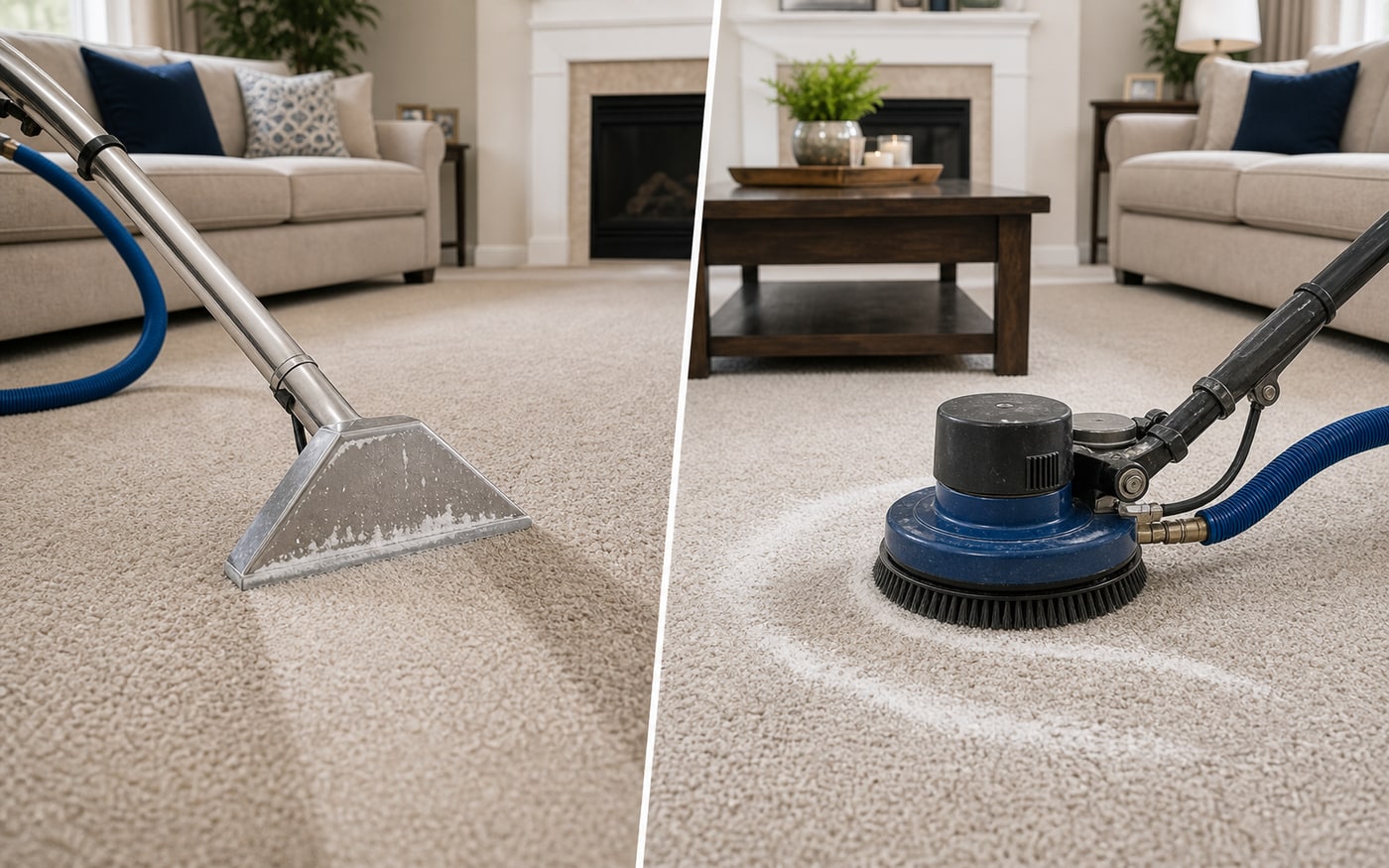
Despite the name, steam cleaning doesn’t actually blast your carpet with steam. It injects hot water and a cleaning solution deep into the carpet fibers under pressure, then immediately extracts the water along with the dissolved dirt, allergens, and oils. A truck-mounted system heats the water hotter and pulls harder than any rental machine, which is why a professional clean removes so much more.
Here’s what’s happening at the fiber level: most of the “dirt” in carpet isn’t loose crumbs — it’s a film of body oil, cooking grease, pet dander, and tracked-in grime that bonds to the fibers and traps fine dust. Hot water plus a cleaning agent dissolves that film, and high-powered suction lifts it out before it can settle back down. That’s the part a vacuum simply can’t reach.
Pros:
- Cleans deepest — reaches soil and allergens near the base of the fibers
- Removes more pet dander, dust mites, and pollen (great for allergy households)
- Flushes out dissolved oils rather than just loosening them
- Recommended by most carpet manufacturers to keep warranties valid
- Best method for treating set-in pet stains and odor at the source
Cons:
- Longer dry time — usually 4–8 hours
- Over-wetting by an inexperienced operator can cause issues, so technique matters
Dry carpet cleaning
“Dry” cleaning is really low-moisture cleaning. There are two common approaches:
- Encapsulation: A machine works a polymer-based cleaning solution into the carpet. As it dries, the polymer crystallizes around each soil particle, encapsulating it. You then vacuum up the dried crystals. It’s fast and popular for commercial maintenance between deep cleans.
- Bonnet cleaning: A rotating absorbent pad (“bonnet”) loaded with cleaning solution buffs the carpet surface. It’s quick and makes carpet look refreshed, but it mostly cleans the top third of the fibers and can leave residue if overused.
Both use specialized compounds and very little water, then rely on vacuuming to remove the loosened soil and dried product.
Pros:
- Little to no dry time — carpet is usable in roughly 30 minutes to 1 hour
- Convenient for offices and spaces that can’t be taken out of use
- Lower risk of over-wetting
Cons:
- Cleans the surface more than the deep base of the fibers
- Can leave chemical residue that attracts dirt faster (re-soiling)
- Generally doesn’t satisfy manufacturer warranty requirements for periodic deep cleaning
- Less effective on deep stains, heavy soil, and embedded pet odor
Side-by-side comparison
| Factor | Steam (hot-water extraction) | Dry / low-moisture |
|---|---|---|
| Cleaning depth | Deep — to the base of the fibers | Surface to mid-pile |
| Dry time | 4–8 hours | ~30 min – 1 hour |
| Allergen/dander removal | Excellent | Fair |
| Heavy soil & set-in stains | Excellent | Limited |
| Pet odor at the source | Best option | Not recommended |
| Residue / re-soiling risk | Low when extracted well | Higher (residue can attract soil) |
| Warranty compliance | Usually required/accepted | Often does not satisfy |
| Best for | Most homes; allergy households | Offices, quick turnarounds |
How long does carpet take to dry?
With professional hot-water extraction, expect 4–8 hours in normal conditions. A few things move that number:
- Airflow. Running fans, ceiling fans, or your HVAC speeds drying dramatically. We set up air movers on the spot.
- Humidity. In a humid Central Virginia summer, drying runs slower; in dry winter air with the heat on, faster.
- Carpet type and pile height. Thick, plush carpet holds more water than low-pile commercial carpet.
- Operator skill. A good tech makes proper extraction passes so the carpet comes up damp, not soaked.
You can usually walk on damp carpet right away in clean socks; just wait until it’s fully dry to replace heavy furniture.
Residue and re-soiling: why it matters
This is the hidden difference between methods. Any leftover cleaning product acts like a magnet for new dirt — which is why carpet that “looked great for a week” can re-soil fast and start to look dingy in the same traffic lanes. Proper hot-water extraction rinses and removes the cleaning agent along with the soil. Low-moisture methods, especially bonnet cleaning done too often, are more prone to leaving residue behind. If your carpet keeps getting dirty quickly after a clean, residue is a common culprit.
Cost considerations
Our professional carpet cleaning starts at $110, and the method we use for a standard home clean is truck-mounted hot-water extraction at no premium — it’s simply our standard. A few popular add-ons let you tailor the result:
- Pre-treatment for heavy-traffic or stained rooms: $15–$25/room
- Pet treatment for odor and protein stains: $15–$35/area
- Carpet protector (re-applies stain resistance): $25–$35/room
Dry-cleaning equipment is cheaper to run, but the trade-off is shallower cleaning and faster re-soiling, so you may end up cleaning more often. For most homeowners, a deeper clean once or twice a year is the better value. See full pricing →
What your carpet warranty probably requires
Major carpet manufacturers typically require professional hot-water extraction on a regular schedule (often every 12–18 months) and may ask you to keep receipts. Relying only on rental machines or low-moisture methods can void coverage if you ever file a wear claim. If warranty protection matters to you, hot-water extraction is the safe path — keep your invoice on file.
Which should you choose? Scenario by scenario
- Family home with pets, kids, or allergies → Hot-water extraction. It removes the dander, pollen, and oils a surface clean can’t, and it’s the right method for pet odor. Pair it with a carpet repair visit if accidents have damaged seams or padding.
- Set-in stains or visible traffic lanes → Hot-water extraction with pre-treatment.
- Busy office or retail floor that can’t close → Encapsulation/low-moisture for fast turnaround, with periodic deep extraction.
- New carpet under warranty → Hot-water extraction to stay compliant.
- Quick refresh before guests, can’t wait to dry → Low-moisture for speed, knowing it’s a lighter clean.
For whole-home freshness, many customers pair carpet cleaning with tile & grout cleaning or air duct cleaning in the same visit.
FAQ
Is steam cleaning bad for carpet? No — done correctly it’s the safest deep clean and the method manufacturers prefer. Problems only come from over-wetting or under-extracting, which is about operator skill, not the method itself.
How often should I have carpets cleaned? Most homes: once a year. With pets, kids, or allergies: every 6–9 months.
Will dry cleaning get pet odor out? Usually not. Pet urine soaks into the backing and pad, so it takes hot-water extraction with enzyme pet treatment to remove the source rather than mask it.
Can I just rent a machine? You can for light maintenance, but rentals heat water less and extract weaker, so they leave more moisture and residue behind — and they may not satisfy a warranty’s professional-cleaning requirement.
At CarpetPros, our standard carpet cleaning uses truck-mounted hot-water extraction, and we set up airflow to speed drying so you’re back to normal sooner. See our pricing or book online anytime.